CONTACT US!

This album of travel inspiration has been brought to you by Melanie @ Tough Love Travel!
Talk to Melanie at (609) 923-0304 or melanie@toughlovetravel.com.
Or visit her at www.ToughLoveTravel.com for "fun adventure to get your out of your box".

Monday, September 10, 2012

Things to do in Santiago Chile: 6 Secrets of Santiago


Visiting Easter Island – a territory of Chile, 2000 miles off into the Pacific – is one the  most special things to do in Santiago Chile.   But what about Santiago’s music, and politics?  And desert?   What about skiing?   Check out my 6 Secrets of Santiago, for off-the-beaten-track things to do in Santiago Chile!

SNOWY things to do in Santiago Chile
You probably know that a giant stretch of Andes lies in Chile, but did you know that, if you’re looking for things to do in Santiago Chile, skiing is right outside the city limits?
Valle Nevada is less than 1 hour  from Santiago – vertical distance, that is!  You switchback from the city streets, straight up to 12,000’, traveling “above the cactus line” to the complex of 3 resorts that service the mountain.

From the top, the mountains roll on and on, one behind the other, like endless waves from a shore.

And the space is hard to fathom --  here is Dan skiing down


And down


And down.
 
 What about all your equipment?   I know an outfitter who can set you up with skis/snowboards, and even coats and mittens – AND deliver you to the lift!


SANDY things to do in Santiago Chile
The Atacama Desert – the driest place on earth! – is just north of Santiago Chile.  You might know the Atacama from the tragic miners' story in 2010.
An unforgettable thing to do in Santiago Chile is to sidetrip into this desert.  There are ancient mummies,  crumbling ghost towns,  active geysers,  landmarks of sand dunes like Valley of the Moons, and lagoons full of flamingos.


(Political) SCIENCE  things to do in Santiago Chile
The story of the Pinochet regime – the threatening years from 1973 til 1990,  shaped Santiago Chile in a way that’s complicated and profound.   A day spent with a political history guide is heavy, but so worthwhile, in order to learn the history and also to gain some insight into how modern-day Chileans continue to process this. 

Start in the city, before the Presidential palace, and hear what happened the day of the coup, when Pinochet’s planes air-raided the palace.
Follow the history out to Villa Grimaldi, where the Regime "disappeared" people during its reign.  Thankfully, today, it is a Peace Park.


SONG things to do in Santiago Chile
This club oozes atmosphere with different types of jazz featured throughout the week -- blues this night, dixie the next, progressive on weekends.  Out of all the musical and cultural things to do in Santiago Chile, this  famous club is a top choice -- it's show you famous as well as local acts!  Check out the celebrities:
It's called Club de Jazz de Stg, and here's where you'll find it: 


SAPPHIC  things to do in Santiago Chile
Well, if not exactly in the Sapphic meter,  Nobel-winning poet Pablo Neruda wrote poetry from his home in Santiago Chile.   When you visit his home, imagine him sitting at his desk, taking inspiration from the art on his walls and scene outside his window, to write his verse.

Here's one of my Neruda favorites:
I want you to know
one thing. 

You know how this is: 
if I look 
at the crystal moon, at the red branch 
of the slow autumn at my window, 
if I touch 
near the fire 
the impalpable ash 
or the wrinkled body of the log, 
everything carries me to you, 
as if everything that exists, 
aromas, light, metals, 
were little boats 
that sail 
toward those isles of yours that wait for me. 

Well, now, 
if little by little you stop loving me 
I shall stop loving you little by little. 

If suddenly 
you forget me 
do not look for me, 
for I shall already have forgotten you. 


SEASHORE things to do in Santiago Chile
One of the easiest daytime things to do in Santiago Chile is a bus ride to Valapraiso.

This small coastal town clings to the cliffs over the harbor about 1 hour west of Santiago Chile.  You can board a skiff for a harbor tour, or ride the funicular up the hill for fantastic views.


There is colorful street art,  and yummy orange juice to buy from street stalls... charming neighborhoods to explore and ceviche to sample.   We hit a local parade on the morning we were there.  

But while you're choosing between things to do in Santiago Chile, don't forget Easter Island -- you'll never regret it!   Check out last week's blog to read more on the Moai!

Monday, September 3, 2012

TRAVEL TO EASTER ISLAND: the mystery of the Moai


MEET THE MOAI when you travel to Easter Island

Standing 20-40’ tall, on the cusp of the south Pacific,


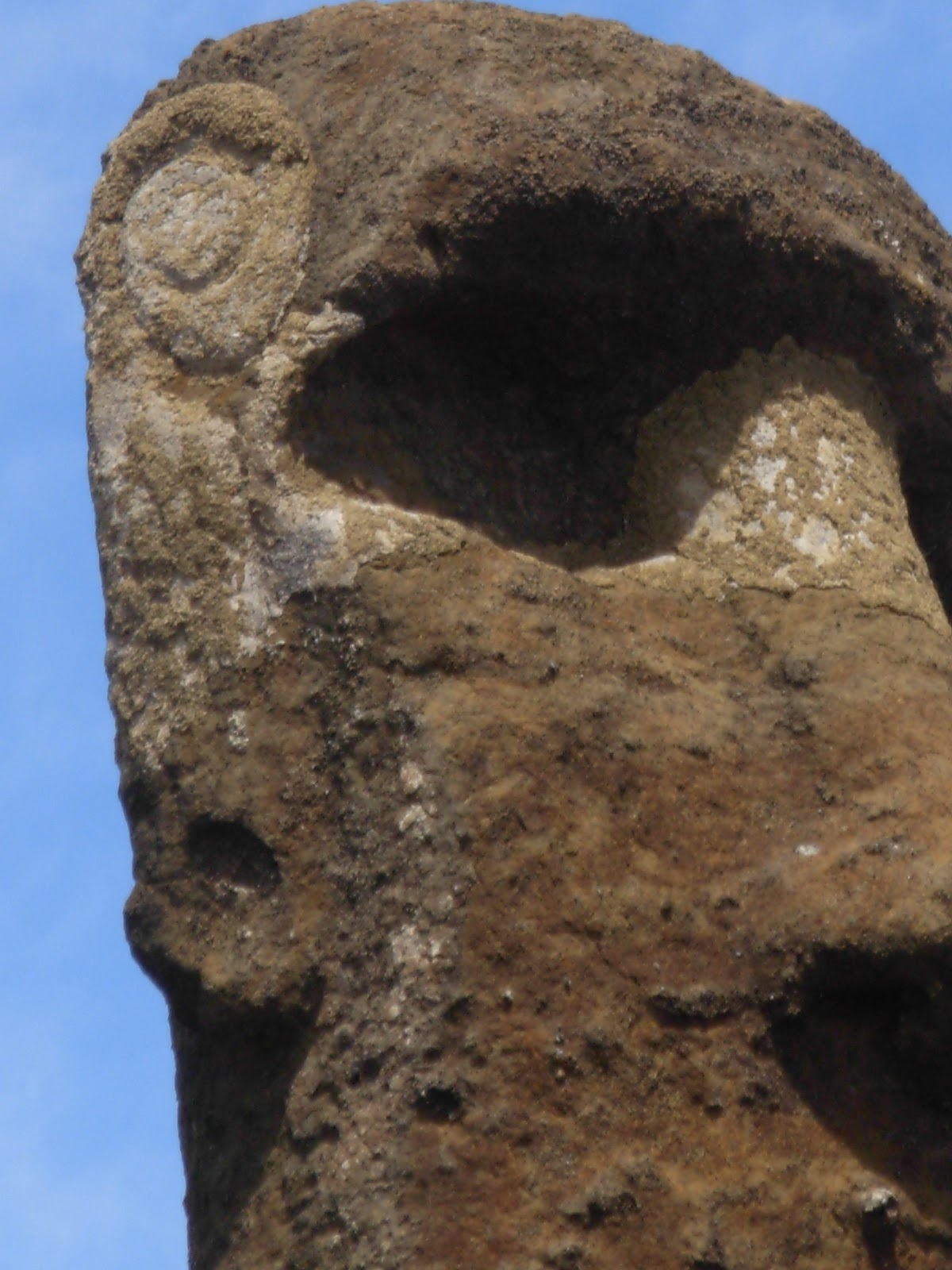
Each unique, representing the natives’ forebears.  This one has an earring, that one a  heavy brow

They’re typically in groups, on their Ahu, or platforms,

And the native Rapa Nuians worship them, as conduits to the gods.

When you travel to Easter Island, spend sunset with the moai.  Sit on the grass before them.  Absorb the heat of the sinking sun, and together, let the darkness fall around you, as one more day closes on this tiny speck in the Pacific.


HOW DID THE FIRST PEOPLE TRAVEL TO EASTER ISLAND
Historians debate this –
Did they paddle from Polynesia? The shape of their dwellings, fishhooks,  and double-blade paddles are all Polynesian, and one early English sailor reportedly spoke to them in a dialect from Bora Bora.

Or did they travel to Easter Island on tradewinds from the coast of South America?   Their precise stonework clearly looks Incan, and their rongo-rongo tablets (wooden tablets that record history) are also found in Peru's southern reed islands.

They arrived around 400AD.


HOW WILL YOU TRAVEL TO EASTER ISLAND
You can travel to Easter Island either eastbound from Papeete Tahiti or westbound from  Chile.   One bonus of travel to Easter Island is the stop in Santiago Chile, where you’ll find the closest skiing, the driest desert, international jazz and some of my favorite poetry from Nobel-prize-winner Pablo Neruda.  Check out next week's blog to read 5 Secrets of Santiago.


WHAT’S THE LODGING WHEN YOU TRAVEL TO EASTER ISLAND?
I know a pair of guides whose guesthouse is ensconced in a bougainvillea-d garden…  who’ll make you fresh guava jam for breakfast… and whose ancestry is almost as storied as the moai themselves.

Her granddad was the archeologist who headed moai restoration in the ‘60s.
His grandmother was the last baby born in a native settlement on Ovahe Beach before the British arrived.

They’ll give you the inside scoop when you travel to Easter Island. Their sister owns a restaurant by the harbor where you can try ceviche!
Their cousin’s a woodcarver whose moai statues, sculpted from the local chinaberry tree, make incredible touchstones to this magical experience.


WHAT’RE THE ACTIVITIES WHEN YOU TRAVEL TO EASTER ISLAND?
Jeep around the island.  Learn ancient history, and hear stories of modern island life (imagine living 2000 miles from a hospital!)  Walk through the quarry – some of the last moai were abandoned there, and one, at 69’,  was simply too large to move!


Pick bananas in the lava tubes  where natives used to grow small crops,sheltered from trade winds.

Rent a bike.  Travel to Easter Island is safe, and you can strike out of your own to explore the sea caves.


Walk around the ahus. The moai tower over your head, detailed with amazing tattoos, Tim-Burton-esque fingers, and fancy headwear.   Watch their faces – they stare straight out, yet feel so present.

Swim in a turquoise bay encircled by dark lava rocks.

When you travel to Easter Island, take a day on horseback along the remote north coast.  5 hours in the saddle is the only way to see the archeological remains in this road-less area.


WHAT WILL YOU LEARN WHEN YOU TRAVEL TO EASTER ISLAND

It’s a microcosm of world history – populations over-consuming limited resources and falling into self-destruction.

Easter Island had abundant seafood and fertile soil, so populations boomed!  Originally ruled by a kingdom set up along the NW coast, the remainder was divided like a pie, with each tribe getting a wedge.   Their “crust” was the coast where they had access to fish, and they crossed each others land only to access the quarry, Rano Raraku, to carve and excavate their Moai.

Trees were cut down to make charcoal for cooking, and also sleds (which were used to roll the moai as many as 50 miles, to their resting place on the ahus, in each settlement). In the ongoing tribal one-upmanship, the moai got bigger and more numerous, until the island was eventually deforested.

Competition created wars. Tribes toppled each other’s moai and even killed.   By the 1700s, when the first colonial ship arrived on Easter Sunday (thus the name), only about 2000  Rapa Nuians remained.

In the 1920s,  England took over the island for sheep herding.  All remaining natives were relocated into a single town, called Hanga Roa, which is where you’d lodge today.   The island’s entire remaining shoreline was left bare, natural, and strangely undeveloped!

Easter Island remains the most remote, continuously inhabited island, on the face of our earth.


HOW MANY DAYS SHOULD YOU ALLOCATE FOR TRAVEL TO EASTER ISLAND?
Easter Island is officially part of Chile, 2000 miles and a $700+ airplane ticket from Santiago.   So, stay 3 or 4 nights. It’s a quiet, small, but thought-provoking place.  You’ll want some time to soak it up.


DO YOU NEED A VISA TO TRAVEL TO EASTER ISLAND? 
No Visa, nor special immunizations, needed for travel to Easter Island. 

An appetite for seafood would be useful, though.

Wednesday, August 22, 2012

Hiking in Cinque Terre: no backpack required!


Hiking in Cinque Terre – that landlocked valley of “5 lands” on the NW Italian coast – promised a priceless taste of Old World Italy.

We envisioned rose-colored villages
…centuries-old foot trails through olive farms in mid-harvest, 
…and fishing dories piled with nets, rocking on the surf.   

Hiking in Cinque Terre did not disappoint. 


Where do you begin hiking in Cinque Terre?
Cinque Terre’s car-free, so we trained from Genoa to the westernmost village, Monterrossa, and set off on foot with our daypacks.

Unlike most Cinque Terre villages (which are crammed into the cleavage of the hills), Monterrossa boasts blocks of waterfront, with surfside cafes and some of Cinque Terre’s only sandy beaches.

Well-marked trailhead?  No, just head to the end of town, and take the last stony path, heading to the water.

You’re off… hiking in Cinque Terre.


What will you see, hiking in Cinque Terre?
A serpentine path… acres of vineyards… terraces and spellbinding seascapes at every angle.


We stopped for a picnic, and fed the colony of stray cats.    After about 3 hours of hiking in Cinque Terre, our first night’s village came into view!


Where do you sleep when hiking in Cinque Terre?
We worked our way down into the crux of the hillside, then took the cut-off to Vernazza.  

Soaked and worried about the approaching dusk, we wound our way into the square and  approached some men at a wharf café to inquire about a room.   But first, I felt a tug at my elbow, and turned to see a squat, wrinkled woman who, with a low mumble and unfamiliar words, beckoned us across the harbor.


We followed her trustingly through a thick wooden door, up some dark stairs, and into a room, straight out of movie set.   Green wooden shutters opened up onto neighbors’ clotheslines and the misty harbor scene spread below…


Hot showers.  Clean linens.  A view.  
…we had achieved the trifecta of travel lodging!
Then we were off, on a dinner “crawl” through town.


You won’t starve while hiking in Cinque Terre
Stop 1:  a wine bar, tucked back in the town center
Curious tidbit:
Medieval villages were strategically designed as a maze of winding alleyways, with the town center predictably tucked deep inside, away from the harbor, protected from invaders

1st course: Belforte Ristorante, in a tower on the cliff’s edge… literally!

2nd course: the Panaramica, for one of the local specialties - Pesto!

Stop 4:  Joining a table of fun-loving strangers for calamari fra diavlo


This plan repeated, at every meal (except breakfast) in every town!  Good thing that hiking in Cinque Terre burns calories!


 We closed out the night in this grotto, eating chocolate!


What towns do you visit while hiking in Cinque Terre?
Next day we walked onward to Corniglia.   We passed our first English-language sign -  “Rooms with a view” (translation was hardly necessary)  

 then ate a lunch which almost swam onto our plate!

Hiking in Cinque Terre takes you down Corniglia’s famous stairs,

along circular paths into Manarola where we splurged on gelato and a nap on the sun-warmed shore rocks.

In summer, you can boat from this harbor to the final town, but – being October – we  stayed on the foot trail.  Our last (and most visited) stop was Via del L’amore, or Lover’s Walk, in Riomaggiore, a sadly crowded and grafitti-ed cobblestone promenade.


Hiking in Cinque Terre offers Old World immersion
The olive groves were in mid-harvest, draped in plastic orange netting, tended by weather-worn farmers who smiled silently but warmly at us.

Above Corniglia, there’s an in-home wine-making operation, and near trail’s end, we came across crypts -- generations of a single family,  laid to rest, beside their sea.


We closed our trek with a train back to Monterossa.  It ran through tunnels and along the sea, but offered no better view than from the trail, hiking in Cinque Terre!


NOTE:   In 2011, bad storms caused flooding and landslides.  Trails are still being restored but most towns are open for visitors.   For more info on hiking in Cinque Terre, go to the National Park site.


Is this adventure "calling your name"?     Let me tell you more about it-- 


Monday, August 6, 2012

TRAVEL TRIBUTES #4: a T-shirt pillow

T-shirts...
you'll buy them from the boat captain or the ranch wrangler,
at the national park gift store or even at the little donut shop you stopped at on the edge of town.

Did you ever think of saving those t-shirts for a travel keepsake?

You can make them into individual throw pillows like these...

Or a larger pillow sham, perhaps for a bed...

If you have a LOT of t-shirts, you can always make them into a quilt

The folks at the T-Shirt Quilt Company make it very easy!  Here's their site!  Make sure to tell them that Melanie @ Tough Love Travel sent you!

Tuesday, July 31, 2012

TRAVEL TRIBUTES #3: photo albums

Years ago, I'd return from a trip and my first priority was to start the washing machine.   Next on the list?   Organize my photos!  By the time my family had grown up, I had 42 albums!

Since digital became the norm, though, photos seem to be relegated to computer albums and facebook posts. 
Drag 'em out!  
Create coffee table albums that people can browse through spontaneously. 
Make printed books for the graduate or grandparent - whomever the trip was celebrating! 
Or organize destination books, with a photo tour of a country or island.
Here are 3 ways:

The Old Fashioned Way: 

Print your photos (easy to do at any local photo store -- just take your camera card and they'll have equipment to make it easy to pick and print)
Then arrange your photos in a traditional album.  
 

PRO: you can include other keepsakes in these albums, like special ticket stubs,  to make it more of a photo scrapbook.
CON:  the photos often yellow over time, from the adhesive on the pages. 


Mac iBooks:


For you Mac-users out there, this is so easy!  It's part of your iphoto program.
Drag your favorite trip photos into a project folder, select your style of book, and click-n-drag your photos.
There are lots of choices for layout, from a collaged-look (left) to a traditional look (right), complete with the old-timey photo corners.


PRO:  It's easy to add text to tell stories or to notate locations.
CON:   Once you make it, you can't remove photos (say, if you wanted to copy them for a family member)


Shutterfly book:


Shutterfly is an online photo storage facility that you can use with ANY computer, not just Macs.
It's very user-friendly,  and after you upload your photos, you can create a free website to share them with your family and friends, 
or you can create and order a printed photo album: 
Here's the site to get you started!


If this sounds intimidating, don't worry!  They've made videos to walk you through each step! 


Want some help getting started?  I'm happy to help!  Email me here!

Keep makin' and preservin' those memories!

Monday, July 16, 2012

TRAVEL TRIBUTES #2: create a travel journal

Here's an idea!  Create a travel journal, bursting with touchstones to your favorite places -- a tuft of pressed buffalo fur, an ATM receipt,  a wine bottle label or dated stamp from the UNESCO site.  I have tons of ideas and tips -- check 'em all out here: 

Want a copy of my complete travel article on travel journaling, 
Tall Travel Tales:  7 easy steps for preserving your precious trip memories!

 just email me here: