CONTACT US!

This album of travel inspiration has been brought to you by Melanie @ Tough Love Travel!
Talk to Melanie at (609) 923-0304 or melanie@toughlovetravel.com.
Or visit her at www.ToughLoveTravel.com for "fun adventure to get your out of your box".
Showing posts with label family vacations. Show all posts

Tuesday, July 22, 2014

Yellowstone: then and now

Yellowstone was the first National Park that I visited as a child and it remains an American favorite today. 
Haven't visited Yellowstone yet?  I can get you there.   Email me to start planning today. 

on the top bunk of our beloved Shasta

I first visited Yellowstone as a 7-year-old.  I was with my family in a Shasta camper - one of those white boxes with an orange stripe down the side (I'm the cute one in red).   We drank warm Tang, gathered with the crowds around Old Faithful geyser, and - believe it or not! - cracked the windows of our Rambler station wagon to feed oreos to the bears.  Yes, our parents instructed us to do this, and the rangers stood by and watched, to make sure it all went smoothly.   That was 1971.


Now, it's 2014 and I'm 47 (about).  Now, the wildlife is well protected by rangers who enforce strict food storage rules and the national park service has launched campaigns, like this one: 

Don't make your car into a bear lunchbox!

Yellowstone's BIG attraction:  
Old Faithful
In 2014, you can plan your trip to watch Old Faithful do its thing by tracking the eruptions on your phone's app, Geysertimes.   

Sleeping and hiking in Yellowstone
And you don't have to sleep in a Shasta.  Stay at the Roosevelt cabins (although they might not be much more luxurious.  They describe their Roughrider cabins as "sparsely furnished" and one visitor walked in and said "Is this even legal?")
At the other end of the luxury spectrum, consider Yellowstone National Park's Old Faithful Inn, the largest log structure in the entire world.  On the list of Historic Landmarks, offering a towering lobby with giant stone fireplace, decorated with copper and iron features, this 1903 lodge is so popular that they offer daily tours. Stay in one of the 350 rooms for about $350/night.

Things to do in Yellowstone National Park
Favorite activities include hiking the steep but short trail down Tower Falls, or driving up to the Mammoth area to view the hot springs.


Wondering how to spend 1-day in Yellowstone, on daytrip up from Jackson?   Start at Old Faithful's geyser, grab a quick snack in the classic Old Faithful Inn, head over to the Grand Canyon of the Yellowstone, and stop by Hayden Point (a lookout over Hayden's sub-alpine Valley, which is along the Yellowstone River between the lake and the Falls) for a chance to peek at bison (and maybe even a bear) -- dusk is best!

Secret Swimming hole at Yellowstone? 
3 miles into Yellowstone NP from the north entrance, before you reach Mammoth Hot Springs, there's a small parking lot on your left.  Park and walk down the trail 400m to the confluence of the Gardiner and Boiling River, and you'll find a small swimming hole known mostly to locals. It's a rejuvenating mix of hot Boiling water and chilled Gardiner water.  This is what it looks like: 

Off-the-beaten-path in Yellowstone?
With over 3 million visitors last year in Yellowstone, you might be thinking "How do I get away from it all to really SEE the park?" 

You can llama trek, horsepack, or even sea kayak to the outer reaches of the wilds, and I have just the guide to escort you. (email for details)

Want a map of the park?

Want to see ALL the highlights? 


Call Melanie's custom design service to make it happen!
(609)923-0304

And stay tuned to my next post about a different season in Yellowstone:  WINTER!

Friday, July 18, 2014

Carlsbad Caverns National Park: bats, caves, and aliens

Quick facts:  
WHERE:  southeastern New Mexico
HIGHLIGHT:  caves and bats

I traveled to Carlsbad National Park with my sons in 2004.  That summer, a new backcountry cave had recently been opened which we toured with special permits, but the highlight of our visit was the sunset show of the bats.  They spiraled out of the cavern each and every evening, counter-clockwise (the same way that toilets flush and eucalyptus trees grow in the northern hemisphere) and we were quite amazed!  (check out video at bottom of blog)
  
Getting to our remote NPs is often a dilemma for the traveler.   How should you physically arrive at Carlsbad and why?
We drove, but you can also fly into Roswell (100 miles away) - the home of the aliens!
By driving on a long road trip, we visited Carlsbad after Big Bend NP in TX and before Saguaro NP in AZ.  (read blogs later this week for these parks)

If you have only one overnight in the park (2 days, 1 night), where would you stay and what would you do?
I'd see the main caverns and stick around for the bat exit at sunset.  Then I'd pre-reserve a special tour for Day 2, like Slaughter Canyon (see below) or the 3-dimensional maze, Spider Cave.
Best wildlife viewing opportunity?
The bats!


Best food?
You'll only find cafeteria food in the park, but in Carlsbad village, there's a sushi spot called Blue Ocean Robata.  Located more than 6 hours from the nearest ocean, it offers quite a unique experience.

Best photography shot?
The Christmas Tree formation inside Slaughter Canyon Cave.

What problems have you encountered there (or heard of others encountering)?
Be ready for close screening prior to entering the caves, because our noses, footwear, and clothing sometimes carry diseases harmful to bats.

What is the “rare find” within Carlsbad NP?  

the road out to remote Slaughter Canyon


The private tour of Slaughter Canyon Cave is extra special.  There's no illumination, no paved walkways.  You have to have a flashlight or headlamp to enter this underground space!  It's a true, wild cave, accessed only by a 1/2 hour hike up the desert mountain, to crawl though the small circular opening.  And, in addition to the untouched stalagmites, there are anthropological remains from ancient peoples who used to collect the bat guano here.   Cost:  $15pp

Any words of warning, or wisdom, for the Carlsbad NP planner?
Take a jacket.  The desert may be 120* outside but the cave is 50* inside. 

Did you know?
The limestone rock that holds Carlsbad Caverns is full of ocean fossil plants and animals from a time before the dinosaurs when the southeastern corner of New Mexico was a coastline similar to the Florida Keys. 
waiting for the bats to fly
If you're looking for a road trip though some of our country's most spectacular scenery and most intriguing National Parks, I would love to talk to you. 
I'm Melanie Tucker, owner and chief designer at Tough Love Travel, where I offer complimentary 20-minute get-acquainted sessions.  Select yours right here.


Wednesday, July 16, 2014

Glacier National Park: scenery, summertime snow, and big-horned sheep

Today begins a series of blogs featuring our US National Parks. 
Here's the first installment, an interview with Bernie, who loves Glacier National Park. 
Have questions?  I am here to help.  Email me here.

Bernie, welcome to the Tough Love Travel blog.   I hear you’re a Glacier NP expert, so tell us...
Q:  Did you know that people often confuse Glacier National Park with Glacier Bay National Park? 
A:  Yes, some people find it confusing, but I have visited Glacier National Park in Montana, for 3 different summer vacations!

Q:  Getting to our remote national parks is often a dilemma for the traveler.   How did you physically arrive at Glacier, and why did you choose this method?
A:  We flew in to Kalispell, MT, the closest airport to the park.   
This minimizes travel time (it’s only a half hour by car to the west entrance), but airline tickets to FCA can be expensive.

Q:  If you have only one overnight in the park (2 days, 1 night), where would you stay and what would you do?
A:  If you are the hiking sort, I would drive the Going To The Sun Road to the east side of the park (assuming you are coming from the west) and spend the night at the Many Glacier Hotel.  There are many beautiful day hikes in the area.  
boardwalk trail over tundra by pass
The famed road is a treat.  It bisects the park from west to east, covering 53 miles.  Allow 2-2.5 hours driving time, plus stops at viewing points along the way.  Stop at Logan Pass and hike a mile or two on the Hidden Lake trail or the Highline trail – both are flat and easy, and the views are stunning!  In the Many Glacier area, there are numerous trails – the Swiftcurrent Pass trail is virtually flat for the first 3-4 miles and passes two lakes along the way.  There is also the Iceberg Lake trail, a 9-mile out and back to a pristine, blue lake that actually has icebergs on it until early August!
down, down, down to Wonder Lake

trail down to Wonder Lake
If you’re not into hiking, you could stay at McDonald Lodge and take one of the red “jammer” bus tours.  The busses are fully restored 1930’s White busses.  They got the nickname “jammers” because the drivers were constantly jamming the gears going up and down the grades on the road.  They have modern engines and automatic transmissions nowadays, so the jamming factor is no more.  They have open tops so that you have an unobstructed view of the peaks as you ride along listening to the guide.  Blankets are provided, because even in the summer it can be chilly early in the morning in an open vehicle.

Q: What is the optimal length of time to spend at the park in your opinion?
A:  It depends on how much you like to hike.  If you are “road bound”, perhaps a day or two is fine.  But with only one road, yet over 700 miles of maintained trails, Glacier is a hiker’s paradise.  I go for a week.

Q:  Best wildlife viewing opportunity?
A:  The wildlife will best be encountered away from the road, which gets a lot of traffic.  On an 8 mile hike on the Highline trail from Logan Pass to Granite Park Chalet, I walked to within a few feet of a mule deer doe, saw a small herd of big horn sheep from a hundred yards, mountain goats, and hoary marmots.

Q:  Best of most unique meals/foods?
A:   Just about anything that comes off my backpacking stove is guaranteed to be “unique”.  

But for lodge guests, I’d suggest the dining rooms at McDonald Lodge or Many Glacier Hotel, which offer a varied menu similar to other national parks.  But honestly, you don’t come here for the food; the mountains are the star of the show.


Q:  Best photography shot?
A:  Probably the one of a mule deer buck sniffing the hand sanitizer at the door of the restroom at Granite Park Chalet.  He looks as if he is waiting to go in.  

But if you like landscape photography, just point the camera in any direction.


Q:  What problems have you encountered there?
I haven’t encountered a grizzly on the trail…yet, but if you spend much time in the back country, you need to take the usual precautions.


 Q:  I hear you think that Glacier NP is a rare find.  What is the rare find within Glacier NP?  (this can be a lodge, a trail, a moment, a program)
A:  That’s easy.  The two remaining chalets built by the Great Northern Railway in 1914 as part of an 8- or 9-chalet system, each one a day’s ride by horse apart, by which the early visitors used to experience the park.  The two that remain are the Sperry Chalet and the Granite Park Chalet.  

Sperry Chalet
Sperry can best be reached by the iconic 13.3-mile Gunsight Pass Trail, which begins at the Jackson Glacier Turnout on the Going To The Sun Road about half way between Logan Pass and the St. Mary Visitor Center. This trail is on any hikers bucket list.  It’s another 6.5 miles from the chalet down to McDonald Lodge via the Sperry trail.  Sperry Chalet is rustic, with no electricity, no heat, no showers.  But they provide dinner the night of your arrival, breakfast the next morning, and boxed lunch or the trail when you depart.

Granite Park is a similar set up, except that you have to bring your own food, which you cook in the kitchen there.  The best way to get there is by another of Glacier’s iconic trails, The Highline, which departs from Logan Pass and travels 7.5 miles along the Garden Wall all the way to Granite Park.  The ridge of the Garden Wall is the Continental Divide, and you have breathtaking views every step of the way.

Q:  Any words of warning, or wisdom, for the Glacier NP planner?
A:  Although Glacier is technically open year round, the road is not completely plowed clear of snow until late June or early July, and the higher elevation trails are not clear until then too.  So, the best time to visit is July-August better to assure full access to the park.  Because the season is so short and lodgings are relatively limited, PLAN EARLY if you intend to stay within the park.  Reservations typically open a year in advance and book up quickly.  Reservations for the two chalets open in October for the following season, and will completely book up within a few days.

The other thing is the weather.  Although daytime summer temperatures are usually comfortable, nights can be chilly, dipping into the low 40’s and upper 30’s at higher elevations (around 6500 ft.).  Bring rain gear and even a couple of items of warmer clothing.  You never know what kind of weather Glacier is capable of – in mid-June this year, they received 15-20 inches of snow above 6500 ft!


If you're interested in National Park experiences, stay tuned to this Tough Love Travel blog over the next 10 days. 
Coming up:   Carlsbad Caverns,  Isle Royale, the Channel Islands, and Katmai!

Would you like to have the help of an expert? 
I'm Melanie Tucker, owner and chief travel designer at Tough Love Travel.

Wednesday, August 14, 2013

My Colorado Crowd taught me: CASA DE JUDY in the Galapagos


I'm Melanie.   At Tough Love Travel I offer the most unusual and unforgettable travel itineraries for adventurous travelers!    Schedule a free phone call today to see how I can help YOU get out on the adventure you've been dreaming of!

If you're going to the Galapagos...

And want to spend some time on the island of Santa Cruz (instead of aboard a boat)....

But want accommodations more intimate than one of the big lodges...

Yet more catering than a private rental....


Check out LA CASA DE JUDY!

It's right on the edge of Puerto Ayora, and a short stroll to town's restaurants, artisan shops, and fish market...


It's got some units with a view of the sea, and big enough to fit a family...

An inner courtyard with a sparkling pool!...

And it's run by -- yes! -- Judy herself!
She started the guesthouse to accommodate visiting scientists, and has now expanded it to 19 units, hosting travelers from all over the globe.

Other ammenities?   Right there at the Casa, you can get a hot breakfast with fresh island fruit...

or relax, away from the bustling port...

or even book local tours....


Have questions?
You can get more info at the Casa de Judy website. (tell 'em Melanie @ Tough Love Travel sent you!)

Or grab a free phone appointment with me, to hear what YOUR Galapagos experience could look like!  I've boated all over the island chain and savoured townlife as well, so can show you how it's done!

Tuesday, August 13, 2013

Lucy taught me: RAFTING WITH ROGUE WILDERNESS ADVENTURES!

Need some vacation inspiration?   Email me at Tough Love Travel, and I'll get you inspired!  

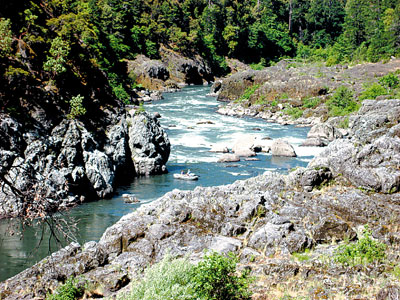
I was delighted to meet Brad, the owner of Rogue Wilderness Adventures, and work with him on a backcountry kayak trip down one of southern Oregon's wild rivers.

WHAT'S THE #1 BEST THING ABOUT ROGUE WILDERNESS ADVENTURES?
Besides the incredible service (from owner down to guides),  the best thing about Rogue Wilderness Adventures is that they take you down sections of the Rogue River which have been closed to the public for 42 years.   Today, it is tightly permitted with only a 120-person daily limit.
What does this mean?
Scenery and Silence!  

SILENCE?  DOES THAT MEAN THAT MY CELL PHONE WON'T WORK?
That's right!  No cell service.  No electricity (even at the lodges).
Lights at nighttime are via tiki torches and lanterns on the river, and by generator at the lodge.

HOW LONG IS THE TRIP?
Rogue Wilderness Adventures does 34-mile stretches of river, covering about 12 miles per day in a combination of inflatable kayaks (IKs)

and paddle rafts.  There're Class III, and even a couple of Class IV, rapids, but you can always find a trip appropriate for your group! 

WHAT ARE MY TRIP CHOICES? 
You can do a 3 day/2night for about $975pp,
or a 4 day/3night for about $1050pp. 

Some of these Rogue Wilderness River trips are camping, while others are a camp/lodge combo. 

WHAT WILL I SEE ON A ROGUE  WILDERNESS ADVENTURE TRIP?
There's abundant wildlife through the Rogue River Canyon -- bald eagles and osprey, otters and mallard, even black bear and cougars!


SO I HAVE TO SLEEP ON THE GROUND?
No!  You can do a lodge trip.  At the historic wilderness lodge, you get your own cabin with a real bed and real linens.
But you may regret it... a camp trip is more rustic, but trust me -- it's unforgettable fun!  And it's easy!  Read on...

IF I CAMP, WHO SET UP THE TENTS AND COOKS?
The guides!  All you do for your "sleeping under the stars" experience is:
#1:  pack properly (they give you an easy list of recommended clothing and gear)
and
#2:  have fun!
Rogue Wilderness Adventure guides set up camp for you and make all the meals, too.

Think of Rogue Wilderness Adventures as a fully-concierge-d river vacation! 


SPEAKING OF FOOD, WHAT WILL I EAT?
Rogue Wilderness Adventures takes full advantage of the abundant agriculture in their state.  


They serve vegetables from local growers like Promiseland Farms, coffee roasted right there in Grants Pass at Rogue Coffee Roasters, and even Oregon wines!


WHERE DOES THIS TRIP START?
Rogue Wilderness Adventures start just outside of Grants Pass, about 4 hours due south of Portland.

WHAT DO PAST ROGUE WILDERNESS ADVENTURE GUESTS HAVE TO SAY ABOUT THEIR TRIP?
"Can we do it again next year?"
... that says it all!

ROGUE WILDERNESS ADVENTURES GOT AWARDS?!
Yes!  Rogue Wilderness Adventures got the Top 50 Outdoor Magazine family adventures for 2013!
WHERE DO I GET MORE INFO ON ROGUE WILDERNESS ADVENTURES?
Check out www.wildrogue.com online.
Speak to a real person at Rogue Wilderness Adventures:  (800)366-1647.
Call me, Melanie, owner of Tough Love Travel, to have your Oregon trip custom-planned, for you! (609) 923-0304!

Thank you, Lucy from PA, for introducing me to Rogue Wilderness Adventures!

Friday, June 28, 2013

The Crying Rock: how my family survived the Grand Canyon!

The summer of '01, my family drove 2300 miles from our home in NJ to take 15,000 footsteps to reach the floor of the deepest canyon in our nation.  But that was only the beginning of our story...


The waking sky had only streaks of yellow and orange when the 5 of us set out to hike to the bottom of the Grand Canyon. 
It was a clear July dawn as we strode off the rim -- fortified by the dining hall's scrambled eggs, stocked with bottles of water and salty snacks (no "death by water intoxication" for us!), sheltered in bandanas and caps, and informed by the Grand Canyon ranger safety video. 
As the waking sun lowered the shadows down the strirated canyon walls, our rocky path grew clearer and the broad canyon vista before us gained depth and color.  The canyon's walls-  layers of rust, black, and mustard - represented centuries, piled atop each other, and as we hiked down through time, it felt surreal, magical.  It felt like entering a chasm.


We descended... snacked... hiked... posed for photos.  

The random stark pine tree stood out bright and lively against the desiccated landscape, but gave no shelter from the fiery sun,  now beaming down on us from the deep blue sky overhead.
Our boots slowly turned dusty gray from the parched trail below us. 
Yet we followed the lone trail, deeper and deeper, into the crevasse.

We crossed over a stream or two, picking our steps from one flat stone to another, and paused to delight over the tinkle of water that flowed through such a stark land.  

By Indian Garden (about mile 4), we were thankful to find shade and water spigets.   And as the July heat intensified, we remembered the popular canyon slogan -- "Hike Wet".  So we started to lie down -- head and all -- in each creek we crossed.   The thermometer had reached three digits. 


After about 6 hours and 7 miles, WE MADE IT! .... or so we thought. 
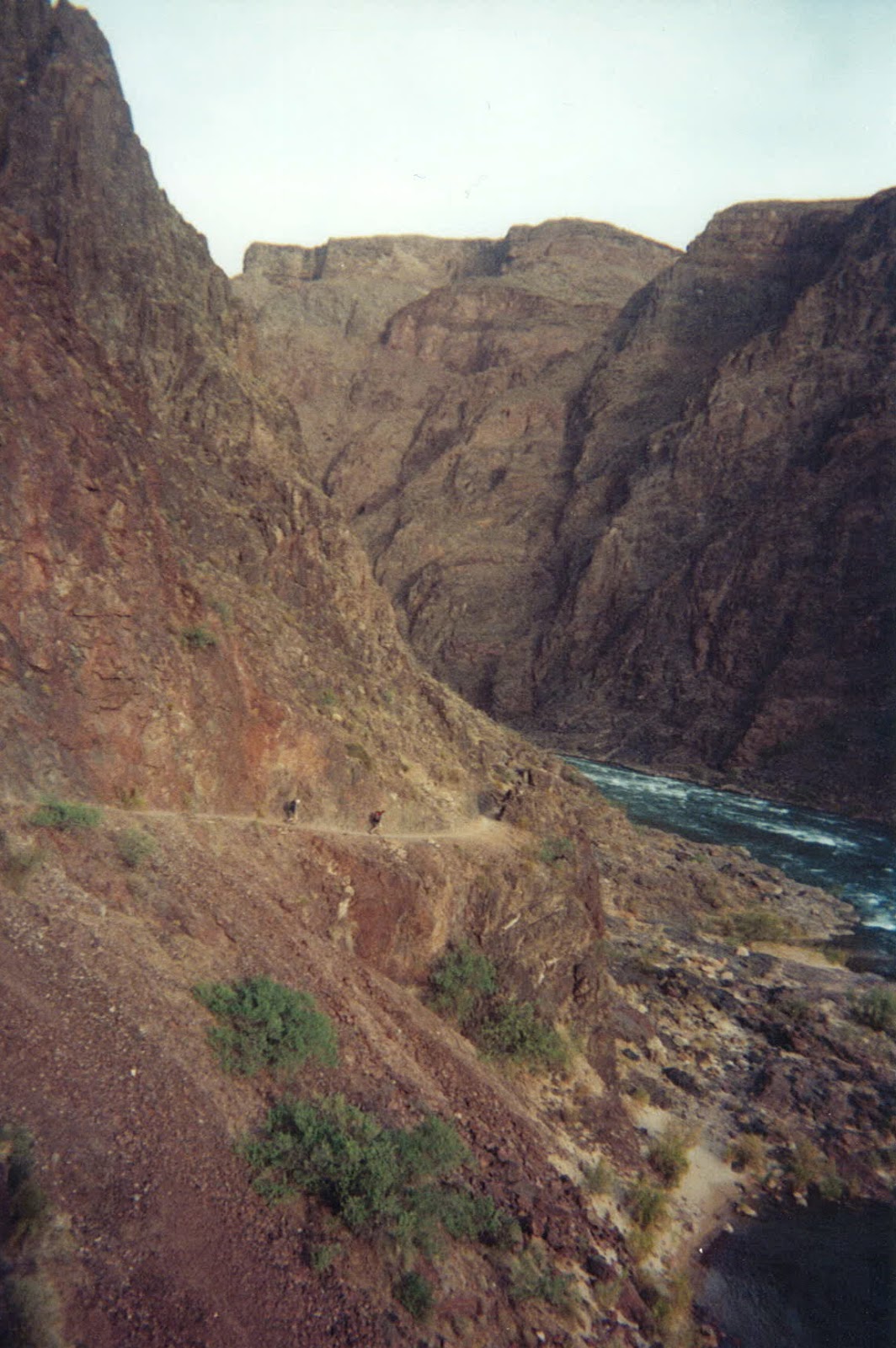
The trail ended, on a cliff edge, below which the Colorado River roared.
With water bottles low and our spirits the same,  our overheated bodies peered longingly at the unreachable water some 30' below -- a painful contrast of 50* rapids in 115* heat.
Somehow, the GC safety video had failed to include this detail. 

With toes at rim, we surveyed our options.  There was really only one. 
The trail took a sharp right-hand turn to follow the rolling river banks, with not a speck of shade in sight. The campground bridge MUST be in that direction. 

So off we trudged. 
But the heat had gotten unbearable, and our resolve was buckling. 

When we thought it could get no worse, the path turned to deep sand -- reflecting the intense heat back on our cheeks, sucking in our burning boots. 

At each twist of the trail, we searched the foreground for some sign of the bridge, and were just too overheated to take the disappointment of endless empty desert before us.

Curves and rises.   Over and over. 
I panted hot breath out of my mouth.  
I sipped  water, like warm bland soup, from my bottle.   
I saw my young crew, staring down at their scorched boots, pushing through the dun sand. 
We were getting dangerously worn down. 

Then around a bend, a giant rock appeared, overhanging the trail.  
Without any discussion, we all 5 scurried to the shade under the rock, and took a collective sigh.

I looked around our circle of red anxious faces.
My 15-year-old outdoorsman was stoic, realizing the severity of our situation. 
My moody 13-year-old was fuming, wondering why he wasn't in music camp in the  Canadian woods right now instead of at the bottom of this inferno.
My 11-year-old, Doug, looked to me, his fearless leader, wondering what I was going to do. 

And that's when I saw the eyes of my 9-year-old, welling up. 
Little Tom, overwhelmed, was cracking. 

My mind sped -- what to say?   how to encourage?  were we even safe?  
I felt genuine fear for the first time, and could sense my own eyes stinging with tears.

Then, magically, Doug stirred. 
He stepped up to Tom and put his arm firmly around his brother's shoulder.   In his best big-brother voice,  with barely a quaver, Doug said, 
"C'mon Tom... there's the bridge.  We'll do it together". 

And with that,  they stepped off. 

The other 3 of us were so stunned that we stepped too.  
Sucking up our own hidden tears, we plowed onward, and before we knew it, the bridge indeed got larger, closer.  The deep sand pulled less.   And we defied the heat -- now well over 120*  around noon -- as we single-mindedly and with a new energy, marched to the bridge,  over the wild rapids, and  to a protective ranger and our campground for the night. 

NOW we HAD made it!
Just feet over the bridge, we tore our packs off and almost ran for the Bright Angel Creek, a small bubbling tributary.  We splashed down, boots and all -- and you could hear a collective "ahhhhhhhhhh".   We smiled -- and even laughed at loud -- at our surviving! 

We spent most of that afternoon in that creek, with short spurts to set up camp or grab food from our packs. 


That evening, we joined the ranger program for a little geology lesson.  
The board at the entrance to the program said:

Take Caution. 
Temperature today: 
137* 

Thank goodness -- we had been saved by the Crying Rock, and a brave 11-year-old boy. 

This blog is dedicated to my 4 sons who, with blind faith and bottomless love (and not much choice, to tell you the truth),  followed  me on our annual 6-week roadtrips all around the United States, each summer of their childhood.   

Friday, May 31, 2013

Wind and Wine: family lore in Hood River!

Here's another great family vacation idea: HOOD RIVER!  offered by Melanie at Tough Love Travel!    Email her today, to get your OWN family out, making memories!
They call it the "Walk of Shame".
Hood River, on the Columbia River's horizontal border between Oregon and Washington, is famous for it's beginner-friendly windsurfing area called The Hook, Those who have learned at Hood River have, sooner or later, been initiated into the Walk of Shame.

The Columbia's relentless eastward breeze at Hood River gives a newbie a steady firm push as he practices his turns, tacking downward, but if he can't yet manuveaur his board upwind,  he eventually has to get off, and walk it:  the Walk of Shame.

At some point (usually day 2 of windsurf camp), he'll master the upwind skill, but until then, the layout of the Columbia river here by Hood River is a perfect training ground.   The Hook --  this arm of shoreline that sticks out into the Hood River current -- resembles a biker's arm, signaling a left turn.  In its enclosure is a large body of river where, on a board, you still enjoy the wind to surf, but you're contained by the Hook so you don't get swept downriver from Hood River to Idaho!

As a mother of 4 sons who had the lack-of-impulsiveness common to teenage boys and were just learning to windsurf, I was very grateful for the Hook!

Here are a couple of shots from surfcamp at Hood River...


In the evening, we sat on the banks by Hood River and watched a wind-surfing competition.  I was amazed at their 30-40mph speeds, and even more by their absolute control, executing airborne stunts and cutting frighteningly close to one another as they challenged each other and the wind.
Later, we wandered up the steep gorge-side streets of Hood River and found healthfood cafes, outdoor gear shops, and a few tattoo parlors.   Hood River is a true windsurfer's mecca!


After a couple days of windsurfing, my sons were sufficiently adept that I could leave them in the hands of their Big Winds instructor, and head across the bridge to Columbia River's  wine country!

Only 60 minutes from Portland, this area is known as "a world of wine in 40 miles".

From Hood River, you can make wine country a simple daytrip,
but there're more than 30 vineyards!  So this area, that's on the same general latitude as European's storied wine countries and which benefits from the volcanic soil of our Northwest' Ring of Fire, can also be a multi-day trip from Hood River.

You can take a river cruise on the UnCruise Line, a small ship that plies the gorge with stops at vineyards, onboard wine seminars, food-wine pairings, and guest speakers.

Or you can embark on your own roadtrip from Hood River.  One great place to start is Cathedral Ridge Winery, in easy reach of Hood River and named Oregon's 2007 Winery of the Year!
In the shadow of snowy Mount Hood!
Message from Melanie, owner of Tough Love Travel...

Summer is not endless!   What do you have planned for yourself, and your family, this summer?  
I am here to help!  Want a 20-minute phone call to talk about the possibilities?  It's free!   Grab one right here!